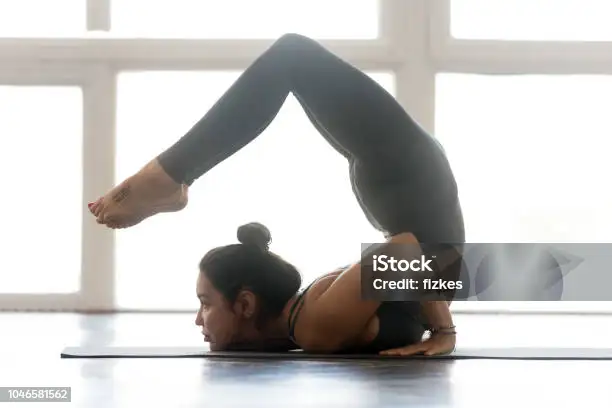
The scorpion is one of the best-known flyer body positions. The flyer stands on one leg and pulls the other foot up behind them, toward or above the head, with the back arched. It looks like pure flexibility, but a good scorpion also takes shoulder mobility, hip flexor length, upper-back extension and balance. This guide covers the stretches and ground drills that build it, and how to work on it safely. For the general basics of stretching, see our stretching guide.
Scorpion on the Ground vs. in a Stunt
You can build scorpion flexibility on the ground on your own. A scorpion in a stunt is different. USA Cheer’s college rules list the scorpion among one-arm stunt positions that require a spotter, and they say skills that haven’t been mastered should be done only in supervised practice. High school and all-star programs follow their own rule sets, so your coach decides when you’re ready and how the stunt is spotted. Practice stunted scorpions only at practice, with your coach, bases and spotter.
What Limits a Scorpion
- Hip flexors and quads of the lifted leg: the leg has to travel back and up behind you.
- Shoulders: you reach overhead and back to grab the foot, so tight shoulders and chest make the grab hard.
- Upper back: the arch should come from the upper back as well as the lower back.
- Balance and strength on the standing leg: you have to hold still on one leg while pulling hard with your arms. See our guide to balance training.
Splits help too. A strong front split, especially the back-leg side, shows the hip flexor length a scorpion needs. Our splits guide covers that.
Protect Your Lower Back
The American Academy of Orthopaedic Surgeons (AAOS) explains that spondylolysis, a stress fracture in a lower-back vertebra, is more likely in young athletes whose sports involve frequent overextension (arching) of the lower back. Scorpions, bow and arrows, back walkovers and handsprings all involve arching.
That doesn’t mean avoiding scorpions. It means:
- Spread the bend. Work shoulder and upper-back mobility so the lower back isn’t doing all the work.
- Build core strength alongside flexibility.
- Don’t repeat deep back bends over and over in one session.
- Take lower back pain seriously. If it keeps coming back or hurts when you arch, stop and see a doctor, athletic trainer or physical therapist.
Hip Flexor and Quad Stretches
- Kneeling lunge: back knee down on a pad, tuck the pelvis slightly, squeeze the back glute and shift forward.
- Kneeling lunge with quad pull: from the lunge, reach back and draw your back foot toward your glute.
- Couch stretch: back knee near a wall with the shin up against it. Ease in. It’s intense.
- Standing quad stretch: hold a wall for balance and pull your heel toward your glute, then gently draw the knee behind you.
Shoulder and Chest Stretches
- Doorway chest stretch: forearms on a door frame, step through gently.
- Overhead triceps stretch: one arm overhead, bend the elbow, and use the other hand to draw it back.
- Strap shoulder stretch: hold a strap or towel overhead with hands wide and slowly take it back. Bring your hands closer as you loosen up.
- Puppy pose: from hands and knees, walk your hands forward and let your chest sink toward the floor with hips over knees. This opens the shoulders and upper back together.
Upper-Back Mobility
- Cat-cow: on hands and knees, move slowly between rounding and arching, focusing on the upper back.
- Thoracic extension over a foam roller: lie with a roller across your upper back (not your lower back or neck), support your head, and gently extend over it.
- Cobra or sphinx: lie face down and press up gently, keeping the lower back comfortable. Sphinx, on the forearms, is the easier version.
Bridges are a useful back-flexibility skill but are a deeper arch. Work on them with your coach’s guidance rather than holding them for long periods on your own.
Ground Progressions
- Prone foot grab: lie on your stomach, bend one knee and reach back for the foot with the same-side hand. Draw it gently toward your head.
- Kneeling scorpion: from a kneeling lunge, reach back with one or both hands for the back foot and lift it toward your head. You don’t have to balance yet.
- Standing foot grab: standing next to a wall for balance, reach back and hold your foot behind you. Stand tall on a straight standing leg.
- Standing scorpion with a strap: loop a strap around your foot and walk your hands down it overhead. This bridges the gap if you can’t reach the foot yet.
- Standing scorpion on the ground: grab the foot overhead with one or both hands, then hold it with control. Work on standing tall rather than leaning far forward.
Only once you can hold a controlled scorpion on the ground on both sides should you and your coach talk about taking it into stunts, at the level and with the spotting your coach decides.
How to Fit It In
- Warm up first. AAOS says stretching cold muscles can cause injury.
- Hold stretches for about 30 seconds, and repeat. Don’t bounce. AAOS warns that bouncing can cause injury.
- Stretch to tension, not pain.
- Work both sides, even if your coach only uses one in routines.
- Short sessions several times a week work better than one long session.
For more flyer training, see our guides to becoming a better flyer and training flyers.
Sources: USA Cheer, 2026-27 College Cheer Rules (general program guidelines and partner stunt spotter rules); AAOS OrthoInfo, Spondylolysis and spondylolisthesis and Warm up, cool down and be flexible. Last checked October 1, 2026.


One thought on “Scorpion Stretches for Cheerleaders: Flexibility and Safe Progressions”