
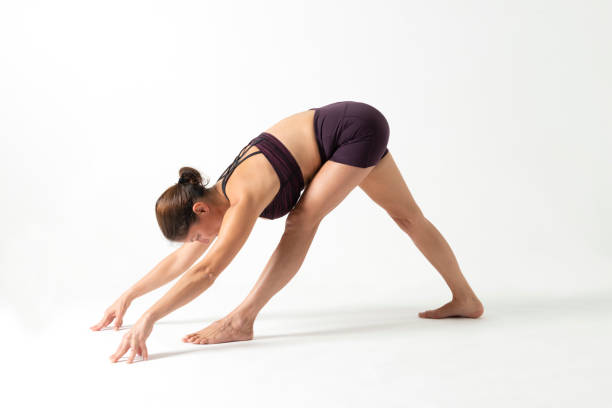
Splits show up all over cheer: in toe touches and hurdlers, in heel stretches and arabesques, and in tumbling. This guide is about one goal: getting your front and middle splits flat, safely. For the basics of when and how to stretch, start with our guide to stretching effectively.
The Splits Cheerleaders Use
- Front splits (right and left): one leg forward, one back. The front leg needs hamstring length. The back leg needs hip flexor and quad length. Heel stretches, arabesques and hurdler jumps all draw on this.
- Middle split (straddle): both legs out to the sides. This needs inner-thigh (adductor) and hamstring flexibility, and it’s the basis of toe touches.
- Oversplits: a split with the front or back foot raised, going past flat. These are an advanced flexibility goal, not a requirement. They put more stress on the hips, so only work on them once your splits are flat and comfortable, and with your coach’s input.
Front Split Stretches
For the front leg (hamstrings):
- Half split: kneel on your back knee, straighten your front leg, flex the foot, and hinge forward with a long back. This is the most direct prep for the front split.
- Lying hamstring stretch with a strap: lie on your back and draw one straight leg up with a strap or towel. Your back stays supported, so you can relax into it.
- Seated pike: legs together and straight, hinge from the hips. Reaching with a flat back stretches the hamstrings better than rounding to grab your toes.
For the back leg (hip flexors and quads):
- Kneeling lunge: back knee down on a pad, tuck your pelvis slightly and squeeze the back glute, then shift forward. Keep your hips square to the front.
- Kneeling lunge with quad pull: from the same lunge, reach back for your back foot. This adds the quad stretch the back leg needs.
- Couch stretch: back knee near a wall or couch with the shin up against it. It’s an intense version of the quad and hip flexor stretch, so ease into it.
Middle Split Stretches
- Butterfly: soles together, knees out. Sit tall and hinge forward gently. Don’t push your knees down with your hands.
- Seated straddle: legs wide, toes up. Reach forward to the middle, then to each leg.
- Wall straddle: lie on your back with your legs up a wall and let them open into a straddle. Gravity gives a gentle, relaxed stretch.
- Frog stretch: on your forearms and knees, slide the knees apart with your shins parallel. Use padding under the knees, and stop if you feel it in the knee or hip joint instead of the inner thigh.
- Side lunge: a standing option that is easy to control.
A Simple Split Session
- Warm up first. The American Academy of Orthopaedic Surgeons (AAOS) says stretching cold muscles can cause injury. Five to 10 minutes of easy movement and dynamic stretching, or stretch straight after practice.
- Stretch the parts that limit you. Pick two or three stretches for the front leg, two or three for the back leg, and a few for the straddle.
- Hold and repeat. AAOS suggests holds of 10 to 30 seconds, and the American College of Sports Medicine recommends a total of about 60 seconds per stretch, for example two 30-second holds.
- Finish in the split. Slide into each split with yoga blocks or your hands taking some weight. Keep your hips square in the front split and your knees and toes pointing up in the middle split. Go only as far as you can control.
- Repeat often. Short, regular sessions beat one long session a week.
If you also want flexibility right before practice, keep the holds short and finish with active movement. A 2016 review of stretching research (Behm and colleagues) found long static holds right before activity can slightly reduce performance unless dynamic activity follows. Our warm-up routine shows how to fit this in.
How Long Will It Take?
There is no reliable timeline, and anyone who promises splits in a set number of days is guessing. Progress depends on your starting point, how often you stretch and your own body, and it is usually slow. Measure progress by photos or the height of your hips from the floor every couple of weeks, not by a deadline.
Stay Safe
- Never bounce. AAOS warns that bouncing in a stretch can cause injury.
- Tension, not pain. AAOS says stretching should not hurt. Mild tension in the muscle is right; pain is a sign to ease off.
- Watch the joints. Sharp or pinching pain in the front of the hip, pain in the knee, or pain in the lower back means stop.
- Don’t let others force you down. A teammate pushing on your hips or back takes away your control.
- Get help for pain that lingers. Hip, groin or back pain that lasts or keeps coming back should be checked by a doctor, athletic trainer or physical therapist.
Once your splits are coming along, put them to work. See our guides to jump height, scorpion flexibility and flying, and our home conditioning workout.
Sources: AAOS OrthoInfo, Warm up, cool down and be flexible; American College of Sports Medicine, position stand on quantity and quality of exercise, 2011; Behm et al., Acute effects of muscle stretching on physical performance, range of motion, and injury incidence, 2016. Last checked October 1, 2026.

One thought on “How to Get Your Splits: Best Stretches for Cheerleaders”