
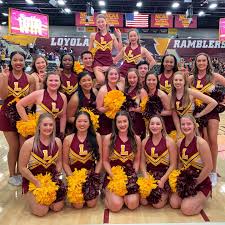
Loyola University Chicago’s cheerleaders are one of three Rambler Spirit Teams, with the Dance Team and the LU Wolf mascots. The teams are run by Loyola Athletics, and cheer and dance tryouts are held each April. For the 2026-27 season, cheer tryouts were held April 10–11, 2026, at the Alfie Norville Practice Facility. As of September 30, 2026, Loyola hadn’t posted its 2027-28 tryout packet. This guide follows Loyola Athletics’ Loyola Spirit Program page and the 2026-27 Tryout Information packet.
The Cheer Team
- A team of up to 24 members that mixes partner stunts and tumbling with traditional yells and chants. Loyola describes the squad as coed (or all-girl).
- The Spirit Teams perform at all men’s and women’s home basketball games, select away games and postseason play, plus volleyball and soccer matches, rallies, alumni events, orientations and fundraisers.
- The cheer team attends UCA camp in the summer and planned to compete at the 2027 UCA College National Championship in Orlando in January. In January 2025, it placed seventh in Division I All-Girl Game Day at UCA Nationals, its third top-10 finish since it began competing in 2022.
- Conference: Loyola competes in the Atlantic 10.
Eligibility
- Full-time undergraduate or graduate student at Loyola University Chicago, for both semesters of the season.
- At least 12 hours of study per semester and a minimum 2.5 GPA.
- Required documents, including Athletics medical forms, turned in by the deadline.
Current and admitted Loyola students are encouraged to try out. Returning members must try out again each year.
How Tryouts Worked for 2026-27
- Optional open practice: Friday, March 27, 7–9 p.m. (not required to try out).
- Day 1: Friday, April 10, 7–9:30 p.m.
- Day 2: Saturday, April 11, in two sections (2:30–5:30 p.m. and 6:30–8:30 p.m.).
- First team meeting: Sunday, April 12, at Gentile Arena.
Tryouts are closed to the public, and cuts are made during the process. Loyola treats the April dates as mandatory and recommends trying out in person. If you can’t attend, contact the coaching staff about alternatives, including a video tryout. Loyola’s Tryouts and Selections page adds that a second tryout may be held in the fall, at the coaches’ discretion, to fill open spots.
What’s Evaluated
- Fight song and sideline chant: motion placement and execution, voice and volume, crowd appeal and timing. Learn the material online before tryouts.
- Partner stunts: range of difficulty, execution and versatility across base, top and backspot. Minimum skills include single-leg stunts (liberty, heel stretch, arabesque) and advanced entries and dismounts (walk-in, switch up, full up, full down cradle). Elite stunts are encouraged but not mandatory.
- Tumbling: not required but highly recommended. Your highest skill is performed on a non-spring mat or a basketball court.
- Coaches also watch coachability, how you interact with other athletes, confidence and potential.
What to Submit Before Tryouts
- The online application form.
- Current students: your fall course schedule and grades, including GPA. Incoming students: your admission decision letter.
- The tryout risk form and the Spirit Teams medical questionnaire.
- A copy of your insurance card (front and back).
- A headshot or current photo.
- A physical completed within the last 12 months (Loyola provides a sports physical form).
- A $25 tryout fee, cash or check payable to Loyola Spirit Teams.
What to Wear
Day 1: a fitted top or T-shirt in Loyola colors, athletic shorts and cheer shoes. Day 2: a black fitted top or T-shirt, black athletic shorts and cheer shoes. Hair goes in a collegiate ponytail (a plain bow or ribbon is optional), with natural game-day makeup. A sports bra alone isn’t allowed, and no clothing may show another college, high school or gym name or logo. No jewelry.
If You Make the Team
- Summer: in 2026, members reported July 26 for practices, then UCA camp July 30 to August 2. Fall reporting was August 14.
- Practice: three evenings a week, plus strength and conditioning. You need permission to schedule classes after 5:30 p.m.
- Support: uniforms, Nike team gear and footwear, strength training, sports medicine care and early registration.
- Costs: team fundraisers throughout the year. Cheer members also have individual fundraising and contribution goals of up to $2,000 for the nationals trip, which are nonrefundable if you leave the team before the season ends.
Coaches and Contact
Monika Wojciechowicz became Loyola’s head cheerleading coach in August 2026. She cheered at Loyola for five years and has worked as a UCA instructor. Beccy Wrona Sullivan is the Spirit Program’s volunteer assistant and mascot coordinator. Email the program at loyolaspirit@luc.edu or the cheer coach at mwojciechowicz@luc.edu. The team is on Instagram at @Ramblers_Cheer.
Frequently Asked Questions
When are Loyola cheer tryouts?
In April. For 2026-27, they were April 10–11, 2026. The 2027-28 packet isn’t posted yet.
What GPA do I need?
A minimum 2.5 GPA, with at least 12 hours of study per semester.
Is tumbling required?
No, but it’s highly recommended. Partner stunting skills are expected.
Can I try out by video?
Loyola prefers in-person tryouts but says to contact the coaches about a video if you can’t attend.
Related Resources
- Northwestern University Cheerleading Tryout Guide
- Butler University Cheerleading Tryout Guide
- How to Base in Cheerleading
- College Cheerleading Tryout Guides Directory
Sources: Loyola Athletics, Loyola Spirit Program, 2026-27 Tryout Information (PDF), Tryouts and Selections, Coaching Staff and Loyola Chicago Wraps Up Cheer Nationals (2025). Last checked September 30, 2026.